6. Roads, Highways and Buses
Positive Plan for Corby · Part 6 of 14
Priority: the Northern Orbital Road, starting with the completion of Eddington Way. Longer-term: A6003 dualling from Rockingham Hill to Fourways Roundabout, a West Corby bypass from the A6003 to the A427, A427 improvements, and A43 dualling to the A1. A seven-day bus network for Corby, and every village around Corby served at least three days a week, then daily by 2035
- Overview and foreword
- 1. Vision and the Greater Corby Growth Area
- 2. Corby as a Central Actor
- 3. Housing and Brownfield Regeneration
- 4. Health: GP, Dental, and Community Services
- 5. Education, including Special Educational Needs
- 6. Roads, Highways and Buses (you are here)
- 7. Active Travel: Cycling and Walking
Corby's road network has not kept pace with its growth. National Highways manages the section of the A43 between the M40 and the M1; the rest is the responsibility of the unitary councils. The A43 'Corby Link Road' from Barford Bridge to Stanion (built around 2014 at a cost of approximately £24 million) provides the existing dualled bypass east of Corby, but east of Weldon the A43 narrows to a slow rural single carriageway around Bulwick and Duddington, and through Collyweston and Easton before reaching the A1. North of Corby, the A6003 Uppingham Road remains single-carriageway despite carrying very heavy traffic.
North Northamptonshire is due to receive over £62 million in Network North highways funding between 2023/24 and 2033/34. We set out one priority scheme and a series of longer-term projects below, and then turn to the bus network. We are clear about the order: the Northern Orbital Road is the single road intervention that unlocks the others, and it is where campaigning effort and feasibility funding should be concentrated first.
6.1 Priority scheme: the Northern Orbital Road
The Northern Orbital Road is the priority road project in this plan. Every other road proposal in this section is worth pursuing, but the Orbital is the one that changes the fundamentals of how traffic moves through Corby, and it is the one that makes several other proposals in this document deliverable.
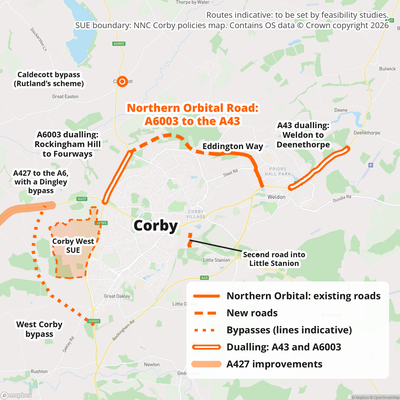
A new ring road around the north of Corby with the aim of diverting HGVs away from the urban roads. This (at least partially) orbital would aim to connect the A6003 in the west to the A43 east of Weldon. Indicative length 10 to 12 km, single carriageway with grade-separated junctions, indicative cost £250 to £350 million. Designed to avoid encroachment on green wedges around Rockingham village, with Rockingham Parish Council holding a co-equal seat in the Joint Infrastructure Forum's published position on alignment. This is a Lib Dem proposal that would require a feasibility study; it is not in NNC's published forward programme.
The first stage is already partly in place. Eddington Way, currently a road to nowhere on the north-eastern industrial estates, should be completed as the first piece of the Orbital. It is the cheapest part of the route and could go ahead while the rest of the route is still being studied.
Why we treat it as the priority:
- It is the only scheme that removes HGV traffic from residential distributor roads at source. Beanfield Avenue, Rockingham Road and the other residential roads that residents consistently identify carry lorries because there is no alternative route between the A6003, the northern and eastern industrial estates, and the A43. Signage and enforcement alone cannot fix that.
- It unlocks the brownfield housing strategy in Section 3.2. The Earlstrees parcels described there are defined as the land 'inside' the Orbital; without the road, that regeneration boundary does not exist.
- It makes the 20 mph and traffic calming programme in Section 6.3 credible. Calming residential streets while they still carry through freight is unsafe and unpopular; giving that freight a proper route comes first.
- It supports the active travel network in Section 7 by taking the heaviest vehicles off the corridors where segregated cycle provision is proposed.
- It is the intervention most often raised, in one form or another, by residents across Greater Corby from Rockingham's concerns about village severance to the town-wide concern about HGVs on residential roads.
Delivery reality check: this is a Lib Dem proposal that is not in NNC's published forward programme and would require a full feasibility study, an alignment consultation, and in all likelihood a Development Consent Order. Our immediate ask is therefore not construction but a funded feasibility study and a committed alignment, with Rockingham Parish Council holding a co-equal seat in the Joint Infrastructure Forum's published position (Section 2.2). Securing that study is the first-phase objective.
6.2 Future road projects to champion
The following schemes are not deprioritised because they lack merit — each addresses a real and evidenced problem. They are sequenced behind the Orbital because they are longer-term, largely depend on National Highways or neighbouring authorities rather than on NNC alone, and in several cases work better once the Orbital exists. Corby Liberal Democrats will champion them throughout the plan period and press for them to enter the relevant national programmes.
A6003: Uppingham Road dualling and a West Corby bypass
The A6003 north of Corby carries an estimated 8,000 vehicles per day through the village of Caldecott alone, where there is a long-running campaign for a bypass supported by Rutland County Council and committed to in their Local Transport Plan to 2036. Within Corby, we propose dualling the single-carriageway section of the A6003 from Rockingham Hill to the Fourways Roundabout, about 2.3 km. Further west, a new bypass through the West Corby SUE would link the A6003 to the A427. The Caldecott bypass is Rutland County Council’s own scheme, and we support it going ahead on Rutland’s timetable rather than waiting behind the Orbital.
| Section | Length | Indicative cost | Status |
|---|---|---|---|
| A6003 dualling, Rockingham Hill to Fourways Roundabout | ~2.3 km | £25-40m | Lib Dem proposal — needs feasibility; costed at the benchmark below |
| West Corby bypass (A6003 to A427, through the SUE) | ~9 km | £140-200m | Lib Dem proposal — needs feasibility |
| Caldecott bypass (Rutland) | ~2 km | £40m | Long-standing local campaign |
Comparator: A43 Phase 3 dualling at £28.4 million for around 3 km gives a benchmark of around £10 million per kilometre.
Improved A427 connection to the A6
Targeted improvements on the A427 west of Cottingham, including bypass option around Dingley. Indicative cost £80 to £100 million.
Dualling of the A43 from Weldon to the A1
Dualling of the 24 km from Weldon eastwards to the A1, currently single-carriageway around Bulwick and Duddington, and through Collyweston. As an initial first phase for the first 3 km, it should go to Deene Park to accommodate housing expansion at Priors Hall, at roughly £40m to £62.5m. The indicative cost for the entire project is £350 to £500 million including the first phase to Deene Park. Funding route: National Highways via the next Road Investment Strategy.
Minor road additions (roughly 1 km)
- St Luke Rd / Long Croft connection from Tesco to Little Stanion to provide a much-needed second access to Little Stanion.
6.3 Local distributor improvements
- Phased rollout of a 20 mph default speed limit on residential streets, retaining 30 mph on classified distributors. The phased rollout would prioritise the neighbourhoods where residents identify it as a top concern.
- Bus priority on Oakley Road and Rockingham Road.
- HGV management plan with camera enforcement, including the negotiated MOU with Constellation Automotive on routing from the Rockingham logistics hub.
- Signal optimisation prioritising buses and pedestrians.
6.4 Buses
This plan has sections on roads, rail and active travel; buses belong alongside them, and until now they have been missing. The bus is the mode used by the residents least well served by everything else in this plan: people without a car, young people getting to Tresham College, older people getting to a hospital appointment, shift workers on the industrial estates. It is also, unlike rail, a mode where the decisions are taken locally. North Northamptonshire Council is the local transport authority, and — as with council housing in Section 3.4 — this is a subject on which Corby can expect rather than ask.
Where North Northamptonshire Council stands
NNC has an Enhanced Partnership Plan for buses, made under section 138G of the Transport Act 2000 and prepared in accordance with section 138H. It adopted its first Bus Service Improvement Plan in 2021 and updated it in 2024, and it is developing its first Local Transport Plan, within which bus improvement will sit.
The council's own BSIP does not pretend the network is adequate. It states that service frequency across the network does not meet current community needs, especially in the evening and on a Sunday, and that growth in car use creates congestion causing delay and timetable unreliability. It notes a greater density of bus routes on the western side of the authority, correlating with the population centres of Corby, Kettering and Wellingborough.
The council has also acted. It has subsidised new routes from its own budgets, from Bus Service Improvement Plan funding and from developer contributions — the one-day-a-week Chatty Bus services, the direct Corby to Kettering General Hospital link on the 2, an evening service to the western estates, and demand-responsive services towards Thrapston and Oundle — many of them replacing services cut from 2017 onwards when the former Northamptonshire County Council removed around £1 million from rural routes. Those additions are real and we acknowledge them.
What is wrong in Corby
The specifics below are drawn from what councillors and residents have said in public at NNC's own meetings, and from the published timetables:
- Connectivity to Kettering General Hospital was raised repeatedly by councillors as inadequate for Corby residents. A direct Corby to KGH service on the 2 was subsequently introduced and is welcome; hospital access remains the most commonly cited gap, and there is no Sunday journey.
- No student discounts are offered on bus routes in the county — it was stated at that same meeting that Northamptonshire is the only county not to do so. For a town whose post-16 offer is concentrated at Tresham College and the Bedford College Group sixth form, this is a direct barrier to education, and it bears directly on the retention problem in Section 5.5.
- Evening and Sunday provision is thin by the council's own assessment. The Corby town centre to western estates evening service runs Mondays to Fridays only.
- Village services are skeletal. Most of the villages around Corby are served by a bus on one or two days a week, or by a single commuter journey, and several by nothing at all (see below). A service that runs one day a week is a lifeline, not a transport network.
- Loss of services on local estates was raised alongside home-to-school transport concerns at the same meeting.
The pattern is consistent wherever residents are asked. Rockingham wants a bus service review. Stanion wants better services to the town centre, station and Tresham College. Great Oakley's historic village core is unreachable without a car because the buses run along the main road past it. Corby Old Village needs more regular services. These are not separate problems; they are one problem appearing in several places.
The villages around Corby: where the buses do not go
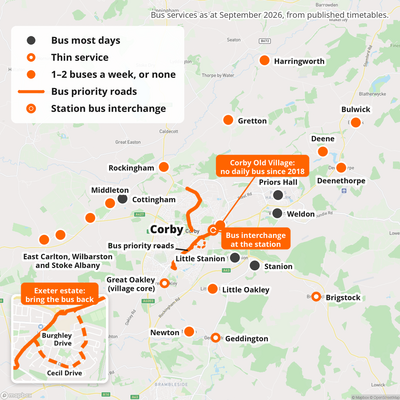
Corby is ringed by villages that look to it for shops, the station, Willowbrook, Tresham College and work on the industrial estates. The table below sets out, as at September 2026 and from the published timetables, what each one actually has. Timetables change, and the table should be read as a snapshot rather than a permanent record; the point it makes will not change without deliberate action.
| Village | Services (September 2026) | What that means in practice | Assessment |
|---|---|---|---|
| Geddington | The 15 (Kettering–Weekley–Geddington–Corby), roughly four to six journeys a day Monday to Friday and two or three on Saturdays, no Sunday; Chatty Bus CB2 (Mondays) and CB5 (Thursdays), one journey each way | A daytime weekday link to both towns, but nothing in the evening, nothing on Sunday, and a long wait between buses | Thin. Adequate for a planned daytime trip; no use for work, college or hospital visits outside office hours |
| Newton and Little Oakley | Little Oakley: a small number of 15 journeys. Newton: no scheduled service identified | Effectively car-dependent | Very little or none |
| Great Oakley (village core) | The 2, X4 and 19 and the Chatty Buses pass along the main road; Rushton community minibus | Frequent buses within a walk of the newer estate; the historic village core itself is not served | Gap for the village core; well served on its edge |
| Gretton | Welland Wanderer West / CB3 (Tuesdays), CB4 to Stamford (Wednesdays), Welland Wanderer East / CB6 (Fridays), one journey each way; a small number of R1 journeys divert via Gretton and Rockingham | A village of over a thousand people with no daily bus | Very little. One of the largest gaps around Corby |
| Rockingham | As Gretton: the Tuesday and Friday Welland Wanderers and selected R1 journeys | No daily service; the village is on the A6003 corridor into Corby but the through buses do not reliably stop | Very little |
| Cottingham | R1 (Melton Mowbray–Uppingham–Caldecott–Cottingham–Corby), nine or ten journeys each way Monday to Saturday; Welland Wanderers on Tuesdays and Fridays | The best-served village on the north side: a regular daytime link to Corby station, Beanfield and Rutland; no Sunday or evening service | Adequate by day; nothing on Sunday |
| Middleton | Welland Wanderer East (Fridays) and West (Tuesdays) only — two buses a week | Residents walk to the R1 stops in Cottingham or drive | Very little |
| East Carlton, Wilbarston and Stoke Albany | LC11 (Market Harborough–Corby), two journeys each way on Wednesdays and Saturdays; Welland Wanderers on Tuesdays and Fridays | One or two buses on four days of the week, none on the other three | Very little |
| Harringworth | Chatty Bus CB4 to Stamford, Wednesdays only, one journey each way | One bus a week | None in any practical sense |
| Deene and Deenethorpe | R1X (Stamford–Corby) commuter service, one early-morning journey towards Corby and one evening return, Monday to Saturday | A commuter link only; nothing for daytime shopping, health or college trips | None in any practical sense |
| Bulwick | Oundle demand-responsive transport (bookable) | Only what can be pre-booked | Very little |
| Weldon and Priors Hall | The 2 (Kettering–KGH–Corby–Weldon–Priors Hall–Little Stanion), Monday to Saturday; X4 (Northampton–Kettering–Corby–Peterborough), now diverted via Priors Hall; CB1 (Mondays) | Regular daytime and evening buses six days a week | Served — the model the other villages should be brought towards |
| Stanion and Little Stanion | The 2 terminating at Little Stanion; some 15 journeys; the 14 to Thrapston, now a bookable demand-responsive service; LC11A to Rushden Lakes; school buses | A regular weekday service to Corby and Kettering; little in the evening and nothing on Sunday | Served by day |
| Brigstock | The 14 (Corby–Thrapston, now demand-responsive); a single 15 journey; LC11A | Sparse fixed-route service, increasingly dependent on booking | Thin |
| Corby Old Village | Bus services run, but not at a regular frequency | The historic core of the town, a short walk from the station, is not served often enough to support its high street or ease parking pressure | Needs more regular services — a gap inside the town itself |
Two things stand out. First, the north and west of the ring — Gretton, Rockingham, Middleton, East Carlton, Wilbarston, Stoke Albany, Harringworth, Deene — have almost nothing: the Welland Valley villages between Corby and Market Harborough are held together by two once-a-week community buses and a twice-weekly service from Leicestershire. Second, even the villages that are served — Geddington, Cottingham, Stanion — have no Sunday service and little or nothing in the evening, so a resident without a car cannot take a Sunday shift, an evening class at Tresham, or a visit to Kettering General outside office hours. The Bus Services Act 2025 now requires NNC to identify socially necessary services and protect them; this table is Corby's starting list.
The powers changed in 2025
The Bus Services Act 2025 received Royal Assent on 27 October 2025, and a statutory instrument in force from 18 December 2025 granted bus franchising powers to all types of local transport authority in England outside London. The requirement to obtain the Secretary of State's consent has gone. The decision is now entirely devolved: NNC can choose to franchise.
The Act also lifts the ban on municipally owned bus companies and, importantly for the greater Corby area, requires authorities to identify and protect socially necessary services from being cut without proper review.
Under franchising, the local transport authority specifies routes, frequencies and fares, and contracts operators to run them. It is the model used in London for decades and in Greater Manchester since 2023. Under the current Enhanced Partnership model, commercial operators decide what runs and the council subsidises the gaps.
Potential targets
| Indicator | Potential target | Notes |
|---|---|---|
| Corby neighbourhoods with a seven-day daytime service | 100% | Including more regular services for Corby Old Village |
| Evening service (after 19:00) on main town routes | 7 days | Currently Monday to Friday only on the western estates route |
| Sunday service on main town routes | Hourly minimum | NNC's own BSIP identifies Sunday as a gap |
| Villages with a service on at least three days a week | All villages around Corby, by 2030 | Most of the north-side villages currently have one or two buses a week |
| Villages with a daily (Monday to Saturday) service | All villages around Corby, by 2035 | The Welland Valley villages first, as set out below |
| Direct service to Kettering General Hospital | Hourly, 7 days | Hospital access repeatedly raised by councillors; no Sunday journey today |
| Student discount scheme | Introduced | Northamptonshire stated to be the only county without one |
| Socially necessary services identified and protected | Published list | New duty under the Bus Services Act 2025; the village table above is the starting point |
| Real-time information at Corby bus stops | All main-route stops | Supports the station interchange in Section 8.2 |
| Zero-emission buses on Corby town routes | 100% | Aligned with the net zero commitment in Section 10.1 |
Franchising — The Manchester Model
The obvious response to the new powers is to demand that NNC franchise its bus network. We are not going to do that without setting out the risk, because franchising is expensive, slow, and transfers revenue risk from operators to the council.
The case for:
- The council would specify routes, frequencies and fares directly, rather than subsidising the gaps left by commercial decisions.
- Cross-subsidy becomes possible: profitable corridors such as the Corby to Kettering X4 can support the village services that will never wash their face commercially.
- Fares, ticketing and network branding can be integrated, which the Enhanced Partnership model has struggled to deliver.
- It is the only model that would let a council guarantee an evening and Sunday network rather than hope for one.
The case against:
- It is slow. Greater Manchester, the only English authority outside London to have franchised, took around five years from decision to first franchised routes, and it is a far larger authority with far greater capacity.
- It is expensive to set up and it moves revenue risk onto the council. If patronage falls, the council carries the loss, not the operator.
- Local authority capacity to undertake franchising was raised as a concern during the Bill's passage through Parliament, and NNC has no in-house bus operations expertise.
- Timing interacts with devolution. Government guidance is explicit that franchising plans need to take account of local government reorganisation, which may have implications for timing and governance. NNC approved a bid for a Northamptonshire Foundation Strategic Authority in March 2026. Committing to a five-year franchising process while the strategic tier is unsettled would be unwise.
Our position: NNC should commission and publish a franchising assessment, the formal comparison of franchising against an improved Enhanced Partnership, rather than either committing to franchise or ruling it out. The assessment should report before any Foundation Strategic Authority is established, so that whichever body ends up holding transport powers inherits an evidence base rather than a blank sheet. In the meantime, everything below is deliverable under the existing Enhanced Partnership.
What Corby would do now, under existing powers
- Publish the socially necessary services list required by the Bus Services Act 2025, with every village in the table above assessed openly, so that no future cut can be made without review.
- More regular bus services for Corby Old Village, so that its high street gains trade and parking pressure on the streets near the station eases.
- Introduce a county student discount, ending Northamptonshire's position as the only county without one, with the scheme covering travel to Tresham College and the sixth form.
- Bring the Welland Valley villages — Gretton, Rockingham, Middleton, East Carlton, Wilbarston, Stoke Albany — up from one or two buses a week to at least three days a week, and then to a daily service by the end of Phase 2, by extending the R1's Gretton and Rockingham journeys and consolidating the Welland Wanderer and LC11 into a regular Corby–Market Harborough service, with demand-responsive operation where fixed routes cannot be justified.
- Give Harringworth, Deene, Deenethorpe and Bulwick a bookable demand-responsive link into Corby on every weekday, on the model already running towards Thrapston and Oundle.
- Add a Sunday service and a later evening journey on the 15 and the 2, so that Geddington, Stanion, Weldon and Priors Hall have a bus to Corby and Kettering General seven days a week.
- Guarantee an evening and Sunday network on the main Corby town routes, funded through the Enhanced Partnership and developer contributions.
- Deliver the bus interchange at Corby station set out in Section 8.2, with real-time information and weather-protected waiting.
- Bus priority on Oakley Road and Rockingham Road, already proposed in Section 6.3, so that buses are not delayed by the traffic they are meant to replace.
- A single published bus map for Corby and the villages around it, covering all operators and community transport, which does not currently exist in an accessible form.
- Secure bus provision through Section 106 on every major development, with services running from first occupation rather than after build-out — the failure mode at Priors Hall and Weldon Park.
6.5 What Corby will press for
- A funded feasibility study and committed alignment for the Northern Orbital Road as the first-phase objective, with Rockingham Parish Council holding a co-equal seat in the Joint Infrastructure Forum's published position.
- Community responses to consultations on major road schemes coordinated neighbourhood by neighbourhood.
- Priority residential streets for early 20 mph implementation identified through neighbourhood engagement.
- A public dashboard, reported through Infrastructure Watch, tracking HGV intrusion complaints and signal optimisation outcomes.
- Shared positions brokered through the Joint Infrastructure Forum with Weldon, Stanion, Little Stanion, and Rockingham on the Northern Orbital Road's alignment.
- A refresh of the 2009 Rockingham Village Conservation Area Appraisal, so that the Northern Orbital Road’s alignment and any development near the village are judged against an up-to-date picture of what needs protecting.
- A review of the planning and coordination of dropped kerbs throughout the town.
- Regulation of parking in residential areas to ensure adequate parking for residents (for example, residents living near Corby Rail Station).
- A Greater Corby Bus Users' Forum, meeting quarterly in public with NNC transport officers and operators attending and the village parish councils represented — the Joint Infrastructure Forum's transport sub-group is the natural home for it.
- An annual Corby bus network report — what runs, when, and what has been lost, village by village — as part of the Infrastructure Watch report.
- A formal Corby response to every NNC bus consultation and to the franchising assessment when it is published.
- Support for community transport schemes, including a Great Oakley community bus pilot, through the community funding routes in Section 13.
- Corby-area detail within the emerging Local Transport Plan, so that Corby and its villages are not treated as an averaged part of an authority-wide picture.
Follow Corby Lib Dems
We're sharing the plan one part at a time on social media. Follow Corby Liberal Democrats to see each film and tell us what you think.
Facebook · Instagram · Bluesky · Threads · TikTok · LinkedIn · YouTube
Want to talk it through? Call Alex Lock on 07794 221431 or message him on WhatsApp.
Want to get involved or have your say? See how to engage with the plan.
Sign up
for email updates