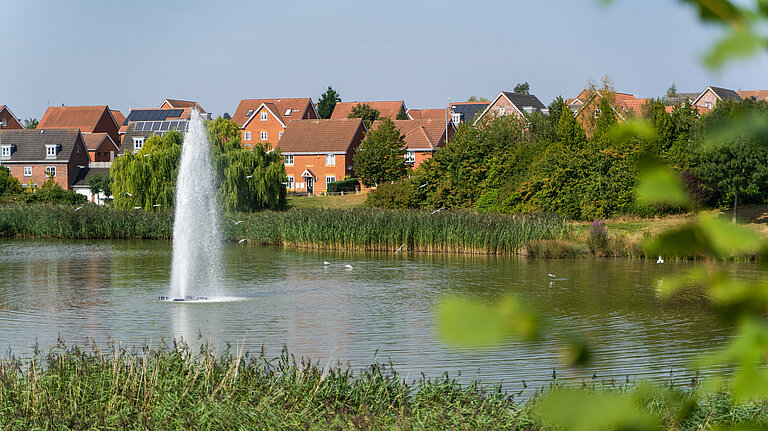
Our Housing Plan
3. Housing and Brownfield Regeneration
Positive Plan for Corby · Part 3 of 14
≈13,500 new homes by 2041; 30% affordable, enforced; brownfield-led; Future Homes Standard now, not when the law requires it; council homes brought up to standard and replaced one for one
- Overview and foreword
- 1. Vision and the Greater Corby Growth Area
- 2. Corby as a Central Actor
- 3. Housing and Brownfield Regeneration (you are here)
- 4. Health: GP, Dental, and Community Services
- 5. Education, including Special Educational Needs
- 6. Roads, Highways and Buses
- 7. Active Travel: Cycling and Walking
The current adopted plan is the North Northamptonshire Joint Core Strategy 2011–2031 (adopted July 2016) plus the Part 2 Local Plan for Corby (adopted September 2021). North Northamptonshire Council confirmed in January 2026 that it is moving to a new combined Local Plan covering the whole authority. The current Local Housing Need figure for the whole of North Northamptonshire under the standard method is 1,978 dwellings per year (2023/24 figure), and North Northamptonshire's 2023 Housing Delivery Test score was 113%.
The largest single housing allocation in the Greater Corby Growth Area is the West Corby Sustainable Urban Extension (Policy 32 of the JCS), which was granted outline planning permission in December 2019 for 4,500 dwellings, three primary schools, one secondary school, employment uses, and supporting infrastructure.
3.1 Housing targets
| Indicator | Target | Notes |
|---|---|---|
| Total net new homes | ≈13,500 | Across Greater Corby Growth Area |
| Affordable homes (% of total) | 30% | As in Joint Core Strategy Policy 30, enforced rather than waived |
| Social rent (% of affordable) | 50% | Allocated through Northamptonshire Keyways |
| Brownfield-led delivery | 60% | Above current NN delivery rate |
| 1- and 2-bedroom homes | 30% | To address starter and downsizer shortage |
| Specialist older persons' housing | 1,200 units | Sheltered, extra care, dementia-friendly |
| Self/custom-build plots | 300 | On serviced sites with infrastructure provided |
| Future Homes Standard compliance | 100% | All new homes, now — ahead of the date the legislation requires it |
3.2 Strategic brownfield opportunities
Rockingham Motor Speedway is no longer available for housing as it was sold to Constellation Automotive Group in June 2021 for £80 million and is in active employment use, supporting around 500 jobs. We support that operation as an employment asset, with active travel and transport improvements to make commuting to it more sustainable.
- Other car storage sites: low-density vehicle storage land through the east of Corby, outside the Rockingham Speedway employment site, should be reviewed as potential brownfield housing sites, adding more value to the people of Corby.
- Earlstrees Industrial Estate, particularly what would be the ‘inside’ of the Northern Orbital road, and any disused spaces there with a view to fill in that space with housing.
- The pockets between Rockingham Speedway, Willowbrook East Industrial Estate and Eddington Way (currently a road to nowhere, and the first stage of the Northern Orbital Road in Section 6.1).
- Weldon Road / former steelworks legacy parcels: continued remediation and release of land where ground conditions allow.
- Cockerell Rd / A6116 parcel that is currently not built on should be looked at for potential social housing.
- Town centre: George Street, Elizabeth Street, and the area around Willow Place to be designated a Town Centre Living Quarter.
3.3 Affordable housing and build quality
Joint Core Strategy Policy 30 currently requires 30% affordable housing on schemes of 15 or more dwellings. Local press has documented that this has been waived on a number of recent schemes on viability grounds — including a Station Quarter scheme that delivered no affordable housing — and North Northamptonshire Council built only 34 council homes against 108 sold under Right to Buy in its first two years.
- Establish an NNC-led delivery vehicle, building directly on small infill sites and council-owned brownfield land to add 100 new social rent homes per year.
- Future Homes Standard as the default now, not later. NNC to seek Future Homes Standard compliance, including solar PV, heat pumps, EV charging, and fabric efficiency, on every new scheme in the Greater Corby Growth Area through the new Local Plan and through negotiation on current applications, rather than waiting for the date on which the standard becomes compulsory. Developers who are already building to it elsewhere can build to it here, and every home that is not costs its occupants more to heat and the town more to retrofit.
- Work with Housing Associations to help achieve our targets and identify more housing stock to make housing accessible to residents with affordable rent. We will also aim to bring empty homes back into use as affordable rented housing.
3.4 Council housing: the homes the council already owns
Most of this plan argues for things somebody else must deliver — Network Rail, National Highways, the NHS, the Police, Fire and Crime Commissioner, a water company. Council housing is different. North Northamptonshire Council is the largest landlord in Corby, and the condition of the homes it already owns is entirely within its own control. For several thousand Corby households the most important piece of infrastructure in their lives is the house they live in, and its landlord is the council. Where the rest of this plan asks, this section can expect.
What the council owns
NNC holds around 8,000 council homes in its Housing Revenue Account, largely across Corby and Kettering, inherited from the former Corby Borough Council and Kettering Borough Council. There is little to no council stock in the former East Northamptonshire and Wellingborough areas. The council's own Asset Management Strategy records that 78% of that stock was built before 1974, and identifies the resulting challenge of ensuring homes meet current aspirations as well as the Decent Homes Standard.
The council has improved its grip on the basic facts. It appointed additional stock condition surveyors and reports that more than 90% of its homes now have an in-date survey, with approximately 1,600 properties surveyed annually on a rolling five-year programme so that every property holds a survey less than five years old. We welcome that. It is the precondition for everything else in this section, and it means the council can no longer say it does not know.
We will not pretend the stock is uniformly poor or that the council has done nothing. It has published its first dedicated Housing Strategy, adopted an Asset Management Strategy, and its Never Give Up rough sleeping team has won national recognition. The argument here is about pace, transparency and priority, and not about a council that has ignored the problem.
The standards the council must now meet
The regulatory ground has shifted sharply, and the timetable is not optional. Phase 1 of Awaab's Law came into force on 27 October 2025. It applies to local authority landlords as well as housing associations, and it requires:
- Emergency hazards: those posing an immediate or significant risk, such as dangerous electrics, major leaks or insecure external doors and windows — to be investigated and made safe within 24 hours.
- Significant damp and mould to be investigated within 10 working days and made safe within a further 5 working days.
The definition of an emergency hazard is deliberately broad and requires landlords to consider the vulnerabilities of the occupants, not only the condition of the property, the presence of a newborn or someone with severe asthma changes what counts as an emergency.
Two further phases follow. From October 2026 the requirements extend to a wider range of hazards including excess cold and excess heat, falls, structural collapse, fire, electrical hazards, explosions and hygiene hazards. From October 2027 they extend to all remaining significant hazards under the Housing Health and Safety Rating System, excluding overcrowding. Alongside this, five-yearly electrical safety checks are now mandatory for new lets and are being phased in for existing tenancies during 2026, and a new Competence and Conduct Standard for social housing staff applies from October 2026.
Phase 2 is the one to watch in Corby. Excess cold in a housing stock that is 78% pre-1974 is not an occasional defect, it is a structural characteristic of the stock. A council that meets Phase 1 comfortably could still be badly exposed once excess cold counts as a hazard, unless retrofit is treated as a compliance programme rather than an environmental aspiration.
Potential targets
| Indicator | Potential target | Notes |
|---|---|---|
| Emergency hazard response (Awaab's Law Phase 1) | 100% within 24 hours | Statutory. Performance published quarterly, neighbourhood by neighbourhood |
| Damp and mould investigation | 100% within 10 working days | Statutory. Made safe within a further 5 working days |
| Homes with an in-date stock condition survey | 100% | Currently over 90%; close the remaining gap |
| Council homes at EPC C or better | 100% | Ahead of Awaab's Law Phase 2 excess-cold exposure |
| New council homes built per year (NNC-wide) | 100 | Against 34 built in the authority's first two years |
| Net change in council stock | No net loss | Right to Buy sales matched or exceeded by completions |
| Temporary accommodation in B&B or hotel | Zero for families | Except in genuine emergency, and then within the statutory six-week limit |
| Average relet time (void turnaround) | Published and falling | Not currently published in an accessible form |
Retrofit — the scale of it
If 78% of roughly 8,000 homes were built before 1974, that is in the order of 6,200 properties across the authority built to pre-oil-crisis thermal standards. Bringing a home of that vintage to a modern standard, insulation, glazing, ventilation designed to work with the insulation, and a low-carbon heat source, typically costs somewhere between £15,000 and £25,000 depending on construction type and what has already been done.
On those assumptions the authority-wide programme is in the order of £95 million to £155 million, and the Corby share would be a substantial proportion of that, given where the stock sits. That figure is our arithmetic on the council's own published percentages and a standard cost range. It is not a costed programme and NNC has not published one. Our first ask is therefore not the money but the number: the council holds stock condition data on more than 90% of its homes and should be able to say what full retrofit of its pre-1974 stock would cost. It should publish that figure.
On the approach itself:
- Fabric first. Insulation and ventilation before heat pumps, because a heat pump in an uninsulated 1950s house produces cold tenants and high bills, and discredits the technology locally.
- Ventilation designed in, not added later. Retrofit that seals a house without ventilating it causes the damp and mould that Awaab's Law now penalises. This is the single most common failure mode in social housing retrofit and it is entirely avoidable.
- Whole-street and whole-block programmes rather than scattered individual properties, which lowers unit cost and lets residents see progress.
- Priority to the neighbourhoods with the oldest stock and the worst reported conditions, informed by where residents raise it most. On what residents tell us now, that is likely to start with Lodge Park, West Lloyds, Beanfield and Danesholme, with the stock condition data confirming the order. Section 10.1 uses the same priority.
- Tenant involvement at design stage, not consultation after the specification is fixed.
Right to Buy and replacement
Section 3.3 records that North Northamptonshire Council built only 34 council homes against 108 sold under Right to Buy in its first two years: a net loss of 74 homes from the social stock in an area with acute affordability pressure.
The national framework has since changed in councils' favour. Right to Buy reforms increase the eligibility period, revise discounts, and exempt newly built homes from sale for 35 years. From 2026/27 councils can combine Right to Buy receipts with Social and Affordable Homes Programme grant, and retain the share of receipts previously returned to the Treasury.
This removes the standard excuse. The financial obstacles that councils have cited for a decade — that receipts were clawed back, that new build could not be protected from immediate resale, that receipts could not be combined with grant — have been addressed. We propose:
- A published one-for-one replacement commitment: every home sold under Right to Buy replaced by a new social rent home, with the running balance published.
- Full use of the new receipts flexibility, with an annual public statement of receipts held, receipts spent, and homes delivered.
- The 35-year exemption applied to every new council home built in Corby, so that stock built with public money stays in public hands for a generation.
- Small-site development on council-owned land — garage blocks, infill, redundant amenity land identified with residents neighbourhood by neighbourhood — rather than waiting for large sites to come forward.
- Acquisition as well as construction: buying back former council homes on the open market where that is cheaper per unit than new build, which on pre-1974 stock it frequently is.
Homelessness and temporary accommodation
NNC's Homelessness and Rough Sleeping Strategy 2024–2029 commits to minimising disruption by housing homeless households in their home area where possible, keeping households fleeing domestic abuse safe, and keeping the temporary accommodation bill down by reducing use of bed and breakfast, hotels and third-party supplier accommodation. The council uses its own housing stock in the Corby and Kettering areas for this purpose, alongside Local Authority Housing Fund and Rough Sleeping Accommodation Pathway provision.
The strategy is sound. What is missing is public visibility of whether it is working. Temporary accommodation costs are the single fastest-growing pressure on council budgets nationally, and residents in Corby have no straightforward way of knowing how many local households are in temporary accommodation, for how long, or at what cost.
- Quarterly publication of temporary accommodation numbers, average duration, out-of-area placements and cost, broken down for the Corby area rather than authority-wide, so that they can be scrutinised publicly.
- A firm commitment that no family with children is placed in bed and breakfast or hotel accommodation except in genuine emergency, and then only within the statutory six-week limit.
- Continued investment in the Never Give Up rough sleeping team, whose work has been nationally recognised, with multi-year rather than annual funding.
- Use of the council's own acquisition powers to convert temporary accommodation spend into permanent stock, on the principle that rent paid to a hotel is money the council never sees again.
3.5 What Corby will press for
- Public scrutiny of every viability appraisal used to reduce affordable housing below policy, with the appraisal published and independently reviewed before the Planning Committee decides.
- Cross-boundary housing schemes — West Corby, Priors Hall, Weldon Park, Little Stanion — taken to the Joint Infrastructure Forum before decision, so that Weldon, Stanion, Little Stanion, and Rockingham are heard alongside Corby.
- NNC and housing associations to build more social and council housing in Corby, using the brownfield sites in Section 3.2 and the delivery vehicle in Section 3.3.
- Future Homes Standard compliance tracked in the annual Infrastructure Watch report, scheme by scheme, so that residents can see which developers are building to it now and which are waiting to be made to.
- A twice-yearly Council Tenants' Forum for Corby, in public, with NNC Housing Services attending and answering questions on repairs, damp and mould, and Awaab's Law compliance.
- Corby-area housing performance, emergency hazard response times, damp and mould cases, void turnaround, temporary accommodation numbers, published in the annual Infrastructure Watch report.
- NNC to publish what full retrofit of its pre-1974 stock would cost, from the stock condition data it already holds.
- Tenants supported in exercising their rights under the Social Tenant Access to Information Scheme, with the Housing Ombudsman route signposted where the council as landlord has failed to act.
- Small council-owned sites suitable for infill social housing identified with residents neighbourhood by neighbourhood and put to NNC.
- Tenants' and residents' associations — including COVNA, East Lloyds Community Association and the BNA, and other residents' associations as they form — treated as the route through which housing conditions are raised and evidenced.
Follow Corby Lib Dems
We're sharing the plan one part at a time on social media. Follow Corby Liberal Democrats to see each film and tell us what you think.
Facebook · Instagram · Bluesky · Threads · TikTok · LinkedIn · YouTube
Want to talk it through? Call Alex Lock on 07794 221431 or message him on WhatsApp.
Want to get involved or have your say? See how to engage with the plan.
Sign up
for email updates