Condemning Reform's attack on the disabled
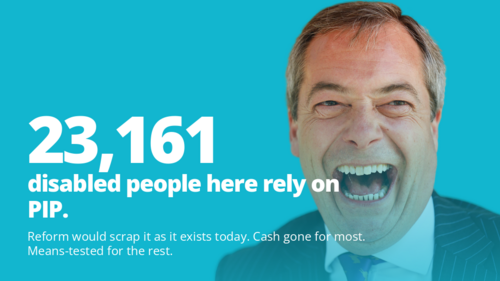
What PIP is worth to this area
| Area | People on PIP | Average weekly award | Value per year |
|---|---|---|---|
| North Northamptonshire | 23,161 | £145.67 | £175.4 million |
| Corby and East Northamptonshire | 7,623 | £145.50 | £57.7 million |
| Wellingborough and Rushden | 7,324 | £144.75 | £55.1 million |
| Kettering | 7,165 | £146.78 | £54.7 million |
Figures: DWP Stat-Xplore, PIP cases with entitlement, April 2026. Annual values are the caseload multiplied by the mean weekly award over 52 weeks. The three constituency figures do not sum to the North Northamptonshire total because constituency and council boundaries differ.
That is £175.4 million a year reaching disabled people across North Northamptonshire. This is money spent on their needs, on their transport, on their local carers. Every penny of it would pass through Reform’s new assessment.
What Reform’s plan actually does
Reform’s document, “Making Welfare Work”, says it will “maintain, reform and enhance PIP”. What it sets out is something different.
- For most claimants, the cash stops. Unconditional cash support is reserved for a narrow list of severe conditions. Everyone else is moved onto a “Disability Support Account” — not money, but an account administered by the local council that pays only for costs someone else agrees to verify. Motability vehicles would be kept for cash claimants only.
- For those who keep cash, it is means-tested for the first time. Reform would means-test the payment under standard Universal Credit rules — against “their own earnings, their partner’s earnings, and their assets”. On those rules, savings above £16,000 mean no entitlement at all, and 55p is withdrawn for every £1 earned above the work allowance. Reform expect this change alone to save £1.8 billion a year.
- Every award shrinks each year regardless. Reform would uprate benefits using a new, lower measure of inflation. In their own words, affected benefits would be “around 0.6% lower” in year one, “around 1.2% lower” in year two, “and so on thereafter”.
- Reform have budgeted for getting it wrong. Their own costing assumes 9.8% of withdrawn cash will be reinstated through mandatory reconsideration and appeals — decisions they expect to lose, after disabled people have already gone without.
Across England and Wales, Reform’s costing puts 2.89 million people through reassessment and takes over £20 billion out of disability support.
"PIP is not a handout. It is the money that covers the extra cost of being disabled for when the taxi when the bus will not do, the heating that has to stay on to ensure their health, and for the equipment the NHS does not provide. It has never been means-tested, because those costs do not disappear when a partner gets a pay rise.
Nigel Farage wants to change that. Under his plan, 23,161 disabled people in North Northamptonshire face reassessment. Most would lose cash altogether and be handed an account the council controls. The rest would find their payment means-tested against their savings and their partner’s wages. As it stand, you can pass Farage's "test" and still lose the money yet still live with the disability
Reform will tell you they are protecting the severely disabled. Read their document. What they are protecting is a shrinking pot, and they have already priced in the appeals they expect to lose. A vile and vicious ordeal to put the most vulnerable in society.
As a parent of vulnerable children, and a member of the Liberal Democrats, we will defend the most vulnerable in society."
- Alex Lock, Local Champion Corby
The Lib Dem Difference
While Reform were drawing up plans to scrap PIP as it exists today, Liberal Democrats spent nearly two years campaigning to make disabled people’s lives easier in a practical, concrete way.
Liberal Democrat MP Tom Gordon campaigned for almost two years to scrap the time restriction that stopped disabled bus pass holders travelling free before 9.30am. MPs voted the change down last year. On 17 August 2026 the Government confirmed the restriction will be removed, backed by £60 million, from April 2027 to ensure disabled people free bus travel at any hour.
Tom Gordon proclaimed it “a huge win for the disabled community”.
That is the difference. One party spent two years working to lower the cost of being disabled. The other has published a plan to means-test it.

Sign up
for email updates